Preview · Page 1 of 3
Meet the Book
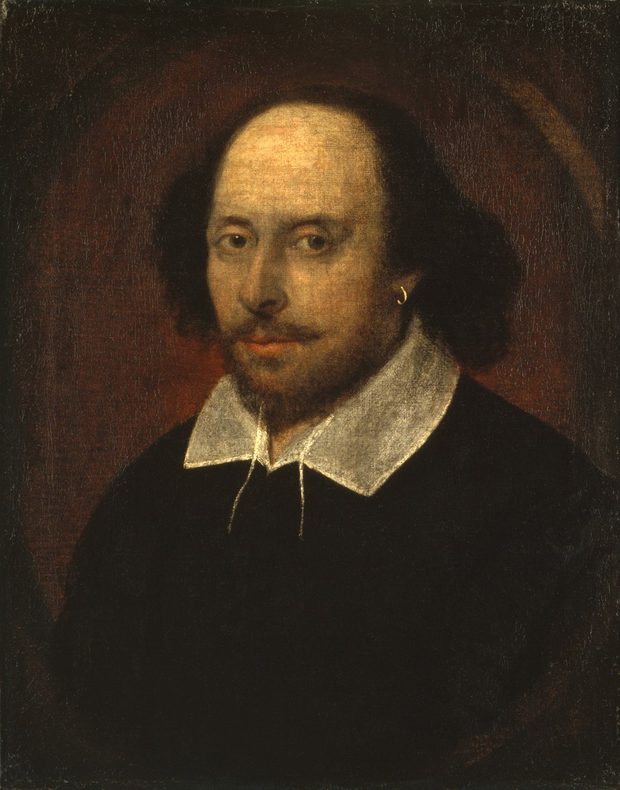

SHAKESPEARE
“Shall I compare thee to a summer’s day? Thou art more lovely and more temperate…” — the most famous love poem in the language, read whole by the man who wrote it, one breath to a line, the way a poem asks to be read.
Press Next to step into the middle of the book — Venus, hunting the hunter.
Preview · Page 2 of 3
From the Middle — Venus and Adonis
SHAKESPEARE
Deep in the poem, a breeding jennet comes out of the copse — and Adonis’s courser snaps girth and rein to reach her. Shakespeare stops his story cold to paint the horse at full fire: ears up-prick’d, nostrils drinking the air, caring nothing for his rider’s angry stir — while Venus watches, for the boy she hunts is about to slip her hands the same way. From here the poem only tightens: the pleading, the parting at dawn, and the boar waiting in the wood.
Press Next to see everything that is inside the whole book.
Preview · Page 3 of 3
What’s Inside
- The Sonnets complete and unabridged — all 154 sonnets in the order the world first read them in 1609 (2,155 lines; Sonnet 99 keeps its fifteen lines and Sonnet 126 its twelve, exactly as printed), and Venus and Adonis complete — his own signed dedication to the Earl of Southampton and all 199 stanzas. 27,409 words, exactly as the editions printed them.
- 3 hours 18 minutes of narration — Shakespeare himself stands in golden light in the corner of the stage and reads his own poems aloud, one breath to a line: verse read as verse, not machinery.
- A period ground beneath the voice — an original La Folia in D minor, the chord measure Shakespeare’s London knew, made for this book alone and played softly beneath the reading the whole way through.
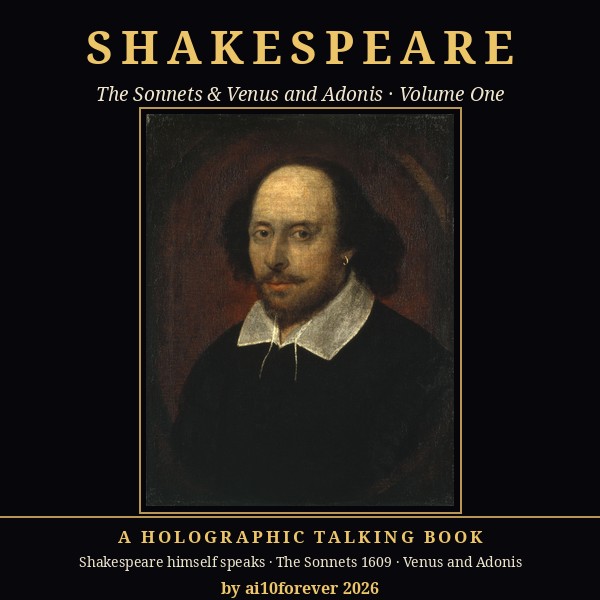
- The Chandos Shakespeare on stage — his own likeness from the portrait painted about 1610, in a gold frame, hangs behind him as he reads, with the book’s golden cover and the bust.
- The barcode rides every stage frame — scan any moment to come back to this bookstore.
- Volume Two follows — The Rape of Lucrece, complete, in the same voice.
The Sonnets (first printed 1609) and Venus and Adonis (first printed 1593) by William Shakespeare — read from Project Gutenberg eBooks #1041 and #1045. The poems and the Chandos portrait are in the public domain; the text is reproduced exactly, complete and unaltered. The narration is a performed reading made for this edition. Editor: Franklin Langston.
$49
franklinlangston.gumroad.com/l/lfjxzp

Point a camera at this barcode to come straight back to this bookstore — and pass it on.